For my presentation on new media I chose to focus on internet video sites such as YouTube. My presentation is in blog form, so you can see that here.
Some of my favorite internet videos from various sites:
Jake and Derek's Road Trip 2: The Lost Footage (from YouTube)
Nick Swardson video making fun of druggies (from Super Deluxe)
Lasse Gjertsen edits video into music (from Dailymotion)
Jake and Amir - "Lyrics" (from Vimeo)
Showing posts with label joseph. Show all posts
Showing posts with label joseph. Show all posts
Tuesday, April 8, 2008

Tuesday, March 11, 2008
The View from the Rear Window

The sheet we were handed in class last week has a short blurb on P.O.V. that asks the question "are there techniques of expressionism or subjective distortions [in the film]?" I haven't seen too many films where there are obvious examples of this type of distortion, but Rear Window sure does have it in droves.
Through the use of lenses (from Jefferies' camera and binoculars), Hitchcock distorts the "naturalistic" P.O.V. tendencies of most films, at least in the technical sense. I use the word "naturalistic" lightly of course, but for the most part, I've only seen films where the P.O.V. is normal, with no framing like those lens-framed shots in Rear Window were. It's irregular, though not incredibly interesting visually. But what it affords Jefferies and the movie's audience is remarkable. A closer view, greater detail, new possibilities for the plot. We discussed this in class, so maybe I shouldn't get too redundant. But even the small amount of visual freedom the distorted P.O.V.s create can translate to a ton of payoff in a film.
I suppose this is all hypothetical, because it's not like Jefferies wasn't going to get this change of P.O.V.... it was written into the screenplay after all. But I'm trying to approach this from within the movie's logic. Notice how the binoculars are the highlight of this poster advertisement for the movie:

And as discussed in class, there is the infamous shot of Jefferies with the camera lens sitting atop his knee, pointed outside and reflecting. Pretty cool how a couple of seemingly minor props can make a movie what it is in the public's consciousness.

Monday, February 18, 2008
Old Media and the Old Testament


Pictured above is John Martin's Seventh Plague of Egypt painting from 1823. The medium is oil painting.
(Note: a lot of this information came from the description pictured under the painting.) The source of the image is from the book of Exodus in the Old Testament. Specifically during Moses' calling for the seventh plague of hail and fire and God's subsequent delivery of said disturbances. Moses and his brother Aaron are the figures in this image. Moses being featured more prominently, standing upright with his hands to the sky. The Egyptian city of Thebes and the stormy sky above it form the background of the painting, but also sort of the focus, as it is much more expansive than Moses' figure. It's also my favorite part of the painting. To me, it's a bit surreal and borderline sci-fi. Pyramids being featured in the same skyline as daunting towers and grand, columned edifices? Not to mention the very cold way that the water and sky are painted. For whatever reason, it looks alien to me.
There seem to be two main, opposing focal points. Those being Moses in the bottom left corner and the white streak/break in the sky in the top right corner. And taken together, maybe they form one main focal point somewhere near the horizon line. This is also where the main light/dark contrast lies. Everything surrounding this center is a lot darker. There are two main color schemes, that are used to distinguish between the land/architecture and nature. The architecture and Moses are colored in warm, browns and reds, while the sky and sea get these cold blues and purples. It's an interesting reversal of what I usually associate with "warm" and "cold" colors. This distinction carries into shape as well where the buildings are made of mostly clean straight lines and nature is more messy and ambiguous shape-wise.
The narrative, as I briefly pointed out before is Moses getting God to rain down some fire and hail on the city of Thebes, Egypt. He wants the Pharaoh to free the Israelites. "Let my people go." The Bible seems to be a lot of metaphor and symbolism (something a lot of people don't care to understand), but I'm horrible at analyzing it. The atheist in me says the subject matter of the Bible is all too convoluted to care about or dissect, but that's probably a little too ignorant. Let's just say this has to do with "freedom" and "natural disasters."

Distortion in the image is more about distorting ideas than physical things. I don't doubt that storms of this magnitude have happened, there are certainly some great pictures of them out there. But the idea of a human being able to summon plagues/natural disasters from the heavens is certainly a distortion of the real world. That's just not possible, though it certainly makes for some good sci-fi and an awesome painting here.
The viewer is placed at a considerable distance from the most vibrant part of the storm. The effects of the storm seem to be at a "safe" distance. And the perspective is above Moses, but still a considerable distance under the sky. Maybe it means that there's a certain amount of "historical" (read: fictional) removal, because the subject matter comes from a pre-existing document. From what I remember, it was a pretty big painting. It mirrors the subject matter in it's larger scale and grandiosity. The oil painting is probably best exemplified in the portrayal of the sky. As I said before, it's ambiguous in shape, very swirly and gauzy. This is a religious painting done in the "English school" style (according to Wikipedia). The subject matter is very much non-English in origin, but the text of the Bible has since been adapted by many people, so I guess you could say it was "universal" at the point of the painting. It's displayed in a golden frame with some Egyptian heads/masks displayed on the bottom of it, connecting it to the Egyptian location of the painting.
Moses is looking to the skies, and we can choose to either look at Moses, the skies or the landscape. It's all pretty mesmerizing and worth looking at. I guess I'm still somewhat confused on the "looking" thing. It falls close to "realism" on the scale simply based on how it's rendered, but it might sit somewhere in the middle, because the subject matter implicates a certain amount of abstraction.
All that aside, John Martin is just a really cool painter. I'm not exactly sure why his style appeals to me, maybe it's just how grand everything is. And the portrayal of things I'd probably never see in real life painted in a realistic way is also interesting to me. Check out this other religious painting of his called The Destruction of Sodom and Gomorrah:

This painting wouldn't seem out of place as an album cover for a metal band. Observe my Photoshopping prowess:

Friday, February 8, 2008
New to Me


One of my favorite spots in the MFA is the impressionism and post-impressionism collection. Our teacher mentioned a particularly interesting series of paintings by Monet that used to be represented in this collection. They were his studies on the seasonal colors of haystacks. For whatever reason, I was always drawn to them. It could be because they were explained during my Art History course, so I felt I had an "understanding" of them and thus, a reason to stare.
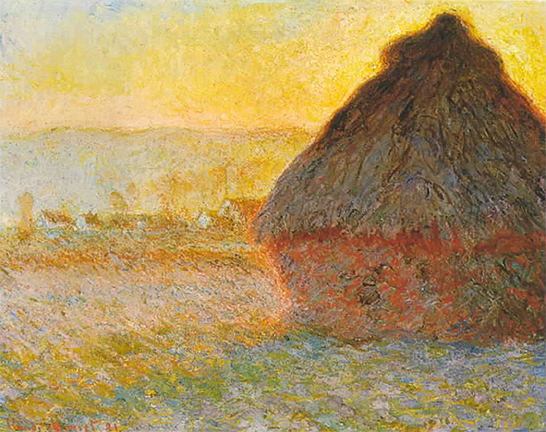
So I expected to see them when the class was in this part of the museum, but what do you know? They were gone. My initial disappointment was replaced by excitement and joy when I discovered that two pointillist paintings had replaced them. I'm not sure I've ever seen pointillist paintings in person until then, so I was pretty wowed. They just look cool, you know?
Anyway, these two paintings are what stood out most to me at the museum. Further online research (er... Googling) led to some more interesting pointillist paintings, specifically by Paul Signac. Peep this self-portrait he did. Sgt. Pepper, eat your heart out.


Subscribe to:
Comments (Atom)